
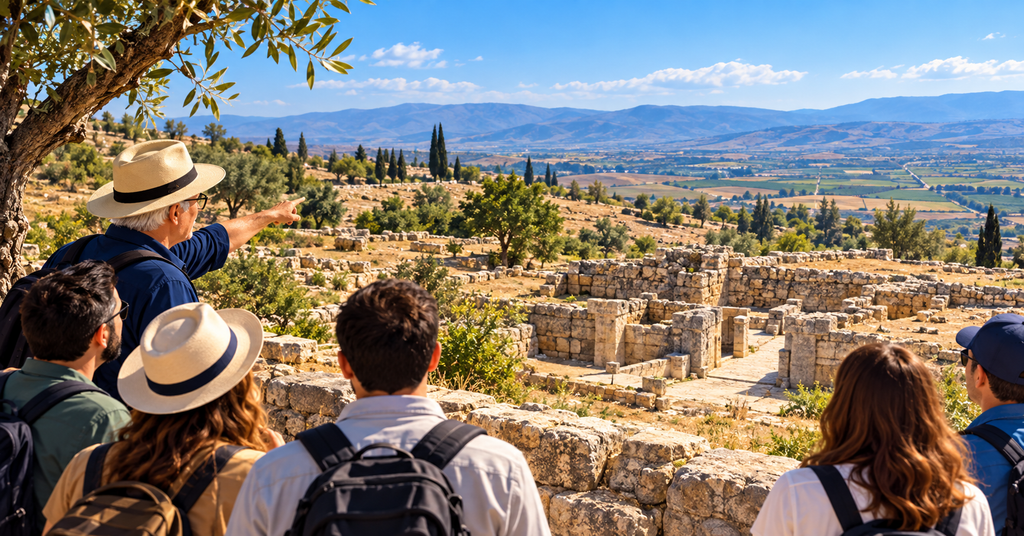
Today I want to take you with me to Tel Hazor, in northern Israel. But before we climb to the top, I want to stop here for a moment, because from this point we can understand something extraordinary about this place.
When we look up, everything we see was built beginning approximately at the level where we are standing. This is what a tel is: a mound formed over time as cities were built one on top of another. A city disappeared or was destroyed, and years later another settlement was built over its remains.
So when we walk through Tel Hazor, we are literally walking through layers of history.
And Hazor has a lot to show us.
From the Time of Solomon to an Even Older City
As we make our way up, we encounter one of the best-known structures at Tel Hazor: a six-chambered gate dated to the 10th century BC and traditionally associated with the time of King Solomon.
But this is where Hazor becomes even more fascinating.
Because we can go further back in time.
Beneath the remains of the Israelite period, we find evidence of a much older Canaanite city. In just a short distance, we can move from structures associated with the time of Solomon to the remains of a city that existed hundreds of years earlier.
And that is when we begin to understand the true scale of Hazor.
In front of us are the remains of a huge Canaanite palace. Parts of the structure can still be seen, including its original floor.
When you stand here and look toward the other side, where the palace continued, you begin to realize just how large it was. We are not talking about a small building or a few isolated stones that survived through time. We are standing among the remains of a city that was tremendously important in this region.
That is something photographs alone cannot fully communicate.
You need to stand here, walk among the structures, and see the distances for yourself to begin imagining what this place once looked like.
Hazor in the Bible
For those familiar with the biblical account, the name Hazor immediately takes us to the Book of Joshua.
In Joshua 11:10–13, Hazor appears as a central city in Joshua’s campaign in the north. The biblical account describes its conquest and destruction by fire.
And this is where things become particularly interesting.
Archaeologists at Hazor discovered evidence of a massive destruction by fire. In some areas of the site, traces associated with that intense fire can still be observed.
Archaeology confirms that Hazor experienced a major destruction by fire, although the exact relationship between that destruction and the account in Joshua continues to be studied and debated by scholars.
For me, that distinction is important.
When we visit the biblical sites of Israel, we do not need to exaggerate what we are seeing. The reality of the place is impressive enough.
We are standing in a city mentioned in the Bible, surrounded by remains from different periods of its history and archaeological evidence of a devastating destruction.
And we can walk among those remains today.
Inside the Ancient Palace of Hazor
As we continue through the Canaanite area, we reach part of the ancient palace.
Here, we can still see its original floor.
Think about what that means for a moment. We are not looking at a modern reconstruction of the floor. We are looking at part of the actual flooring that belonged to this ancient complex.
We also find an area associated with the religious and sacrificial practices of that period.
Some of the lighter-colored stones visible today were added later to reinforce and preserve the structure. This is worth pointing out because not everything we see at an archaeological site necessarily belongs to the original construction. Some additions are there specifically to protect what has survived.
The same is true of some of the walls.
There are areas we cannot approach because the original structures need to be preserved. After so many centuries, our responsibility is to observe them without contributing to their deterioration.
The Traces of Fire
There is another detail at Hazor that can easily go unnoticed unless someone points it out.
In certain parts of the ruins, we can distinguish darker areas associated with the fire that destroyed this phase of the city.
When you know the account in Joshua and then physically stand inside an ancient city that did experience a major destruction by fire, the visit takes on another dimension.
That does not mean we should make archaeology say more than it can demonstrate. It means we now have before us the historical and archaeological setting of a city we also know from the biblical text.
Being able to give place, scale, and landscape to names we have read so many times is one of the reasons traveling through Israel can be such a special experience.
But Hazor still has another story to tell us.
Looking at the Landscape Explains Why Hazor Mattered
Many centuries after the Canaanite city, Hazor continued to hold enormous strategic importance.
In 732 BC, during the expansion of the Assyrian Empire, the city was conquered by the forces of Tiglath-Pileser III.
To begin understanding why this place mattered so much, we only need to lift our eyes from the stones for a moment.
From Tel Hazor, we can look across the valley stretching before us.
Suddenly, the geography begins to explain the history.
This region was connected to important routes leading toward Damascus and the lands farther north. Controlling this area meant controlling an important strategic passage.
When we read a date in a history book, we learn that Hazor was conquered.
When we stand here and look across the valley, we begin to understand why.
And that difference is exactly what I want people to experience when they come with me to Israel.
The Bible Changes When We Know Its Geography
Tel Hazor allows us to encounter several different periods of history in a single place.
We climb a tel formed by cities built one upon another. We walk beside a gate traditionally associated with the period of Solomon. Archaeologically, we move backward into a much older Canaanite city. We enter the remains of its enormous palace. We encounter traces of destruction by fire and, finally, lift our eyes toward the valley to understand the strategic importance Hazor would continue to have centuries later.
It is all here, in one place.
That is why I always say that reading the Bible from home is one thing, but coming to the Holy Land and experiencing its geography is something completely different.
The names are no longer simply names.
Hazor has a height. It has a valley. It has gates, walls, floors, and layers of cities that we can still observe today.
And once we know the place, we can return to the biblical text with a better understanding of the setting in which these events took place.
That is what I want to show you when we travel through Israel together.
Not just the stones.
I want us to look at those stones, look at the landscape, open the Bible, and understand why this place has such an extraordinary history.
Shalom from Tel Hazor.
Explore Tel Hazor with Gershon and discover the layers of this biblical city, from ancient Canaan and King Solomon to the Assyrian conquest.